
The government believes firms which are subject to China's laws could be forced to hand over information to Beijing's security services.

A solution to motion leaks would be to lower the sample rate of the sensors

Reliance Jio may not ask for a premium for its 5G services in the initial stages of the launch, according to sources in the company. The company will roll out 5G commercial services in four cities -Delhi, Mumbai, Chennai, and Kolkata - around Diwali this month and slowly ramp up the processes for other cities, too. A senior executive, when asked whether Jio will charge higher tariffs for 5G against 4G, said: "In the initial stages, customers have to adopt 5G, then they will have to find value in the service, and then one can look at monetisation."

Though leading brands like Samsung, Apple, Xiaomi, OnePlus, and Oppo managed to absorb the initial lockdown shock and resumed their local production back to 60 per cent, they would likely suffer a 20-25 per cent loss of sales in the October-December quarter.

Is self-reliance the right approach in a mega-buck game, or better to be part of a network? asks T N Ninan.

Will open radio access network technology (O-RAN) disrupt the way 5G networks roll out in the country? After all, it promises to offer a substantially lower capital cost, enables the choice of an array of vendors, and provides more network flexibility - all very important for telcos who expect to invest over Rs 60,000 crore to roll out a pan-India 5G network and that's without spectrum costs. But more importantly, it counters the stranglehold of global telecom gear makers such as Ericsson, Nokia, and Samsung over telcos to whom they sell propriety technology and bundled hardware and software.

Under these rules, telecom gear makers have to share their source codes and get their equipment tested by third-party labs accredited to the government.

The announcement quells fears among some telcos that Chinese players might be banned from participating in 5G trials and roll outs.
Just a few weeks ago, Communications Minister Ashwini Vaishnaw did some tough talking with the senior managers of Bharat Sanchar Nigam Ltd, the ailing state-owned telecom service provider. The message was clear: They had to perform, quit by taking the voluntary retirement package or be compulsorily retired from service. The terse message from an otherwise polite and soft-spoken minister came just days after he announced a second and bigger package of Rs 1.64 trillion as part of a four-year turnaround plan for BSNL.

The Cupertino-based Apple unveiled its latest version of iPad in the US earlier this month.

The TicWatch C2 from a Chinese wearable maker Mobvoi is now officially available in India through its website and online retail partner Amazon.
.jpg)
The company isn't talking about plans for marketing the Apple Watch

With consumers staying indoors and e-commerce firms extending their reach to a larger number of pin codes, these giants have snatched a larger share from the offline traders this season.

By the end of 2017, the Chinese firm had emerged as the fastest growing brand after posting 343 per cent growth with 19 per cent market share for the full year.
The move comes against the backdrop of the US and some of its allies banning the purchase of Chinese telecom gear over security concerns and pressuring other countries to follow suit.
Samsung Electronics and Motorola are gearing up to launch handsets based on Google's Android operating system in India.

Cashing in on the interest generated in the three-dimensional world by films like Avatar, consumer electronics companies like Samsung, LG, Sony and Panasonic are gearing up to cajole Indian consumers to buy a 3D TV set

In the coming weeks, online retailers are expected to further raise the pitch with shopping festivals, discounts, and cashback offers.

The industry is expecting double-digit growth on a year-on-year basis, helped by a possible price correction after softening of raw material inputs and factors such as positive sentiments, pent up demand and improving economic conditions. Besides, a shift in consumer behaviour from price consciousness towards technologically advanced premium products with quality, value proposition and safety aspects leading to a rise in demand for home automation products is making the industry upbeat. With the government's production linked incentive (PLI) scheme for white goods, which has witnessed a committed investment of Rs 4,614 crore, in place, many manufacturers are gearing up to make the most out of the opportunity as well as take steps towards reducing their dependency on imports and make products more affordable.
It has invested $2 billion and spent $200 million on its R&D centre in Bengaluru, the largest such centre outside China where some core technologies are under development.

The base model is estimated to be priced at Rs 30,000.

At Rs 56,900, the Samsung handset sets the benchmark for Android phones.

The Department of Telecom on Tuesday approved applications of telecom companies -- Reliance Jio, Bharti Airtel, Vodafone Idea and MTNL -- for conducting 5G trials but none of them will be using technologies of Chinese entities. The list of telecom gear makers approved for trials include Ericsson, Nokia, Samsung, C-DOT and Reliance Jio's indigenously developed technologies.

Samsung's flagships never skimp on top-end hardware and this S6 no different.

Recently, Prime Minister Narendra Modi met over 40 CEOs across broad swathes of industry, ranging from makers of mobile devices, auto components, food products to telecom networking equipment and pharmaceuticals. The agenda: To discuss how to make India an integral part of the global supply chain. The focus of the discussion would be the much touted yet not so well understood production-linked incentive scheme (PLI), the centrepiece of the government's drive to massively boost the manufacturing sector. To do so, the government has created a war chest of over Rs 197,000 crore to be paid out as incentives to over 14 industries in five years. There are three objectives to the scheme, two explicitly stated, one implied.

Based on industry estimates, telecom companies, including Bharti Airtel, Reliance Jio, Vodafone Idea and BSNL, are expected to invest over $10 billion on buying 5G telecom equipment in the next five years as they transition from non-standalone networks to standalone 5G networks.

The Tata group's tryst with mobile services, with either CDMA or GSM technology, did not really fly, forcing it to close operations and write off losses. Now the group is back in the big game, this time straddling the telecom equipment, network and technology space in India as well as the global market. To this end, it is leveraging the opportunities that flow from 5G technology through open radio access network, or O-RAN. Recently, the Tata Sons' subsidiary Panatone Finvest acquired 43.3 per cent in Bengaluru-based telecom equipment manufacturer Tejas Network for Rs 1,850 crore and announced it would buy another 26 per cent of the voting capital through an open offer.

DoT is even considering measures to urge private telecom operators to bring down their dependence on Chinese-made telecom equipment.
Reliance is leveraging the technological change of building a virtualised 5G network which would see the current hardware-dependent networks shift to software-centric platforms.
Just to promote govt's policy of Make in India, BSNL said, it cannot afford to procure sub-standard equipment from inexperienced companies, not having proven technology. BSNL complained that when competitors were procuring world-class 4G equipment from experienced vendors, why should BSNL be compelled to procure locally.
The mobile -- billed as the world's slimmest phone at 6.5 mm thick -- will go on sale in 31 markets, including Britain, Germany and China, starting this month for 449 euros ($630) without a SIM card or service contract.

Despite its 4k and multimedia capabilities, there were other glitches, says Abhik Sen.

Which sectors will bounce back fast? Which will lag? Has the consumer changed forever? Here are some answers.

From OnePlus' Concept One smartphone to the Microsoft Xbox Series X, Khalid Anzar lists the top 6 gadgets we can look forward to in 2020.
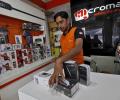
At least two of them - Lava and Micromax - are arming themselves against the Chinese rivals which made them insignificant in the local market over the past few years.
Huawei came under a cloud after allegations that the firm's electronic and telecom devices helped China spy on US corporations and agencies.

These are some of the most anticipated wearable gadgets of 2015

Here is what we expect will be the top innovations of 2015

These are some of the most eagerly-anticipated gadgets likely to grace the Mobile World Congress 2015 in Barcelona between March 2 and 5. We expect plenty of fireworks!
 © 2026 Rediff.com - Advertise with us - Disclaimer - Privacy Policy - Sitemap - Feedback - About us - Terms of use - Grievances